27.01.2021
How to Build a Shower Wall Lining with Blue Board?
In this article we explain how to build wall lining for a shower enclosure with Blue Board.
Tools and products you need:
- Blue Board GMFH1IR
- Blue Board TB 3.9x30 mm Super Premium Screw C5
- Hole Saw Ø 60 mm
- Utility Knife
- Drywall Screwdriver
Here are the steps we followed:
Before we proceed to the wall lining we must have completed the construction of the shower enclosure with the anti-corrosive profiles.
We pass the water supply pipes through the precut openings in the CW profiles. Then we take Blue Board GMFH1IR and mark the position of the taps on the board. Using a hole-saw we drill 2 openings with a diameter of 60 mm.
We cut a small rectangular piece from one end of the board with a utility knife so that the corner pipes can fit in it.
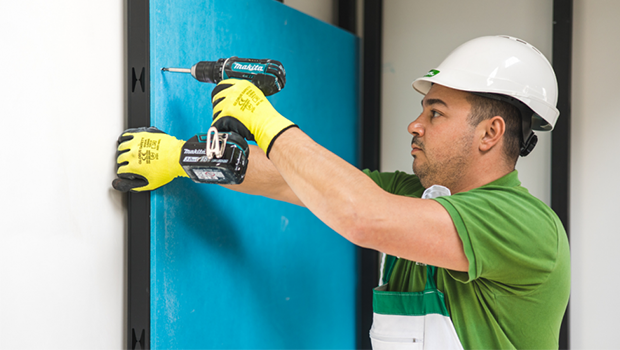
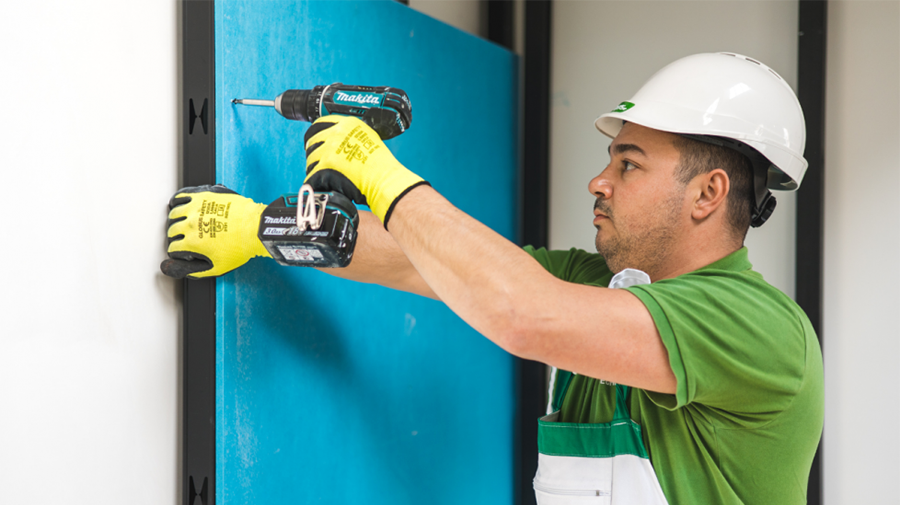
Using a drywall screwdriver, we mount the boards to the vertical CW profiles with the special anti-corrosive screws – Blue Board TB 3.9x30 mm Super Premium Screw. The screws must be fixed at a distance of 10 mm from the edges of the board. The screwdriver must be held perpendicular to the board, so that the angle between the board and the screw is 90 degrees. The screw head should penetrate 1 mm below the surface of the board, and the free end of the screw should enter at least 10 mm into the hollow space of the profile.
We repeat this action for the other 2 sides of the shower.
Additional information:
Depending on the environmental conditions (possibility or presence of condensation in places with swimming pools, places with chemical pollutants, partition walls and linings near coastal areas or in industrial facilities, etc.) it is recommended to use special profiles and accessories reinforced with additional anti-corosion coating. Providing high level protection against corrosion guarantees that the metal stud frame of the system solution will remain unaffected by an aggressive environment for a long period of time.
The different classifications of profiles and accessories you can use are:
- Class C3-C4 - Spaces where condensation is frequent, with high levels of air pollutants caused by manufacturing processes, e.g. industrial facilities, places with swimming pools, public changing rooms and shower rooms.
- Class C5 - Buildings and areas subject to constant condensation, intense humidity and high levels of pollutants e.g. sea water or thermal baths.